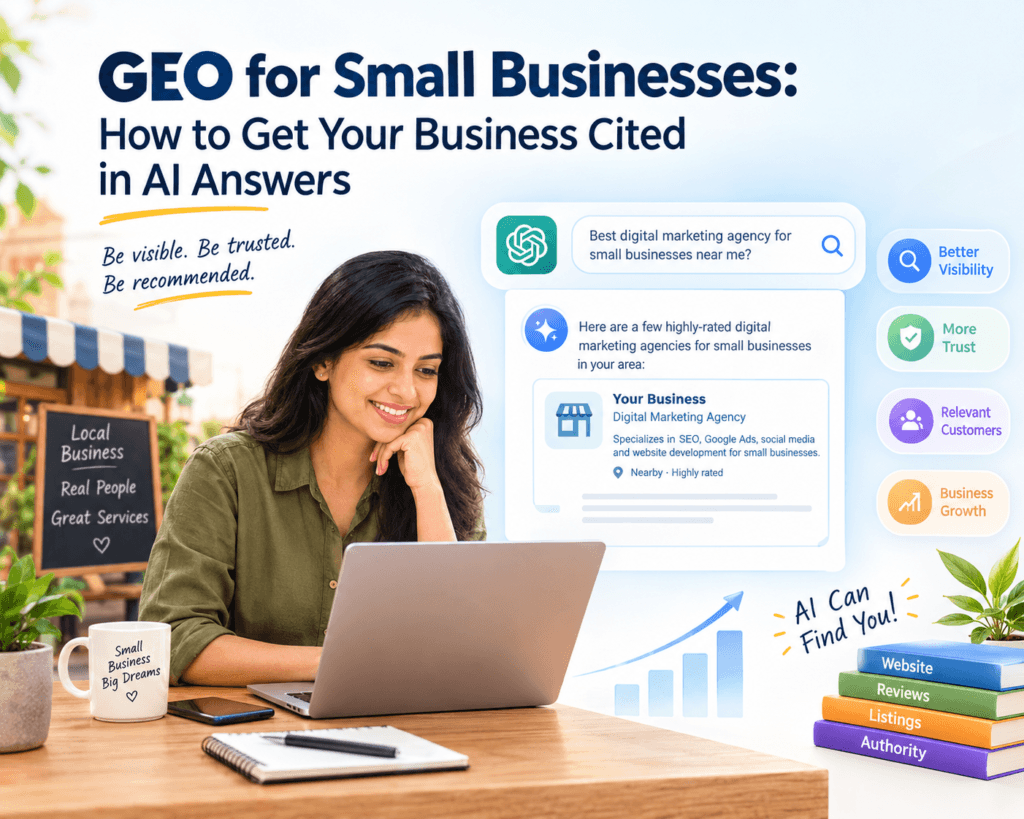
Generative Engine Optimization (GEO) is changing how customers discover local and niche businesses. This practical guide explains how small businesses can improve their visibility across AI-powered search and answer platforms by making their websites clear, credible, useful, and easy for AI systems to understand.
Suggested meta description: Learn how GEO for small businesses can improve AI visibility, strengthen online authority, and increase the chances of being mentioned or cited in AI-generated answers.
Table of Contents
ToggleWhat Is GEO for Small Businesses?
What does GEO for small businesses?
Generative Engine Optimization, often referred to as GEO, is a novel method of enhancing your online presence in order that AI tools will be able to discover and understand your business. The aim is to ensure that when a person uses ChatGPT or some other AI search tool and asks for a recommendation, your business is associated with useful and reliable information which is taken into account as part of the answer.
You probably already know what SEO is. While traditional SEO is mainly concerned with getting your website to appear higher in the results of search engines such as Google, GEO goes a step beyond this. Rather than just aiming to get people to click on your website, it seeks to offer information that AI systems can understand and make use of when responding to a customer’s question.
It’s in this area that **GEO for small businesses** can make a real difference. More and more people are asking AI tools questions like, “Which digital marketing agency is best for a small business?”, “What is the best SEO company near me?” or “How much does website design cost?” Should your website clearly answer such questions and your business details are consistent throughout the web, then you’ll have a better chance of being noticed in the AI-generated responses.
For a small business GEO simply does not involve producing a large number of articles or employing sophisticated technical techniques; it mainly consists of clearly explaining the nature of your business, the sort of people you help, the areas in which you operate, and what distinguishes your business. If your website, business profiles, reviews, and all other online references give a consistent account, then both customers and AI systems will be able to understand your business more easily.
In simple terms, GEO tailored for small businesses involves making it easier for AI to find, understand, trust and possibly recommend your business.
GEO vs. SEO: What Is the Difference?
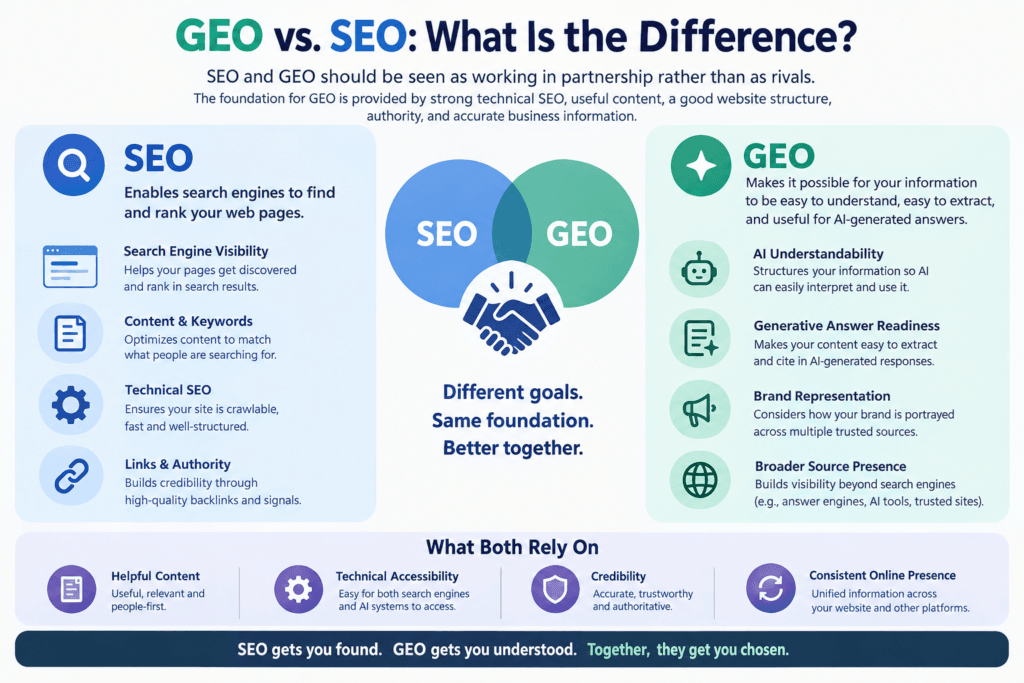
SEO and GEO should be seen as working in partnership rather than as rivals. The foundation for GEO is provided by strong technical SEO, useful content, a good website structure, authority, and accurate business information.
SEO enables search engines to find and rank your web pages.
GEO makes it possible for your information to be easy to understand, easy to extract, and useful for AI-generated answers.
While SEO places a strong emphasis on search visibility, GEO also takes into account how your brand is portrayed in a number of reliable sources.
Each of the two methods relies on helpful content, technical accessibility, credibility, and a consistent online presence.
Why GEO Matters for Small Businesses
Large brands are not automatically the best answer for every customer question. Small businesses can compete by being more specific, locally relevant, transparent, and knowledgeable about the customers they serve.
A Practical GEO Advantage
A clearly written service page that answers real customer questions can give an AI system useful information to work with. When that information is supported by consistent business details, genuine reviews, relevant mentions, and credible content, the overall online picture of the business becomes stronger.
Key Takeaway
Think of GEO as making your business easier for both people and AI systems to understand and trust.
How AI Search Systems Find and Select Business Information
The exact technology differs between platforms, but the process can be understood in four broad stages.
1. Discovery and Retrieval
When an AI-powered search experience needs current information, it may retrieve relevant material from search indexes, websites, business listings, and other sources.
2. Relevance and Quality Evaluation
The system looks for information that directly addresses the question and comes from sources that appear relevant and credible. Clear, specific passages are easier to interpret than vague marketing statements.
3. Answer Generation
The system combines useful information into a response. Depending on the platform and query, it may identify or cite sources that contributed to the answer.
4. Existing Knowledge
When live retrieval is not involved, an AI system may rely on information already available within its underlying knowledge. This is another reason why a business benefits from a consistent, well-established presence across the web.
7 GEO Strategies for Small Businesses
Step 1: Make Your Website Accessible to Search and AI Systems
Before creating more content, make sure important business information can actually be discovered and read.
Check Crawling and Indexing
Review your robots.txt file, security settings, CDN configuration, and other technical controls to ensure you are not unintentionally preventing important crawlers from accessing your public pages.
Keep Important Information in HTML
Services, locations, contact information, pricing guidance, and frequently asked questions should be available as readable page content rather than being hidden entirely behind scripts or interactive elements.
Technical Essentials
- Use HTTPS.
- Maintain a mobile-friendly website.
- Keep pages reasonably fast.
- Maintain a clean XML sitemap.
- Fix broken links and important technical errors.
- Check that key pages can be indexed.
Step 2: Create Content That Answers Real Customer Questions
Useful GEO for small businesses content starts with the questions customers actually ask. Instead of beginning with a long introduction, provide the answer early and then explain it in more detail.
Use Question-Based Headings
Headings such as “How much does digital marketing cost for a small business?” or “Which SEO service is right for a local company?” closely reflect natural search and AI queries.
Make Every Section Stand on Its Own
AI systems may extract a passage without using the entire page. Write sections so the meaning remains clear even when a paragraph is viewed independently.
Prioritize Specific Information
Where appropriate, include locations, service areas, timeframes, pricing ranges, processes, examples, and clear definitions. Specific information is generally more useful than broad promotional language.
Step 3: Demonstrate Real Experience and Expertise
GEO is not simply a content-volume strategy. A small business should show why its information deserves attention.
- Add author information and relevant professional credentials.
- Publish original case studies and project examples.
- Share practical lessons from real customer work.
- Use trustworthy sources when making factual or statistical claims.
- Review important content regularly and update outdated information.
- Make About and Contact pages clear and complete.
Use AI as a Tool, Not as a Substitute for Expertise
AI can help with research organization, drafting, editing, and content planning. However, the strongest business content should still contain human judgment, first-hand experience, original examples, and accurate information.
Step 4: Strengthen Your Business Entity and Structured Data
AI systems need to understand what your business is, what it offers, where it operates, and how it relates to other entities. Clear structured information can reduce ambiguity.
Use Relevant Schema Markup
Depending on the business and page, structured data may include Organization, LocalBusiness, Service, Product, Article, Person, FAQPage, Review, or AggregateRating markup where applicable and compliant.
Keep Business Information Consistent
Your business name, address, phone number, opening hours, services, and other important details should be consistent across your website and major business listings.
Local Visibility Matters
For local businesses, keep your Google Business Profile and other relevant listings accurate, complete, and current. Consistent information helps customers and search systems understand the business more confidently.
Step 5: Earn Trusted Mentions Beyond Your Website
Your own website is only one part of your online identity. Reviews, local publications, industry websites, professional communities, videos, podcasts, partnerships, and reputable directories can all contribute to a broader digital footprint.
Focus on Genuine Mentions
Encourage genuine customer reviews and participate in relevant communities by being useful rather than promotional. Avoid fake reviews, spammy link schemes, and artificial attempts to manipulate visibility.
Build Local and Industry Authority
Consider expert commentary, guest contributions, local partnerships, webinars, interviews, community involvement, and original research that gives other websites a reason to mention your business.
Consistency Is the Goal
When several independent, credible sources describe your business consistently, customers and automated systems have more information with which to understand your brand.
Step 6: Structure Your Pages for Easy Understanding
Good formatting improves usability for people and can also make information easier for automated systems to interpret.
- Use one clear H1 and logical H2 and H3 sections.
- Keep paragraphs focused and reasonably short.
- Use lists and tables for comparisons and specifications.
- Place a concise summary near the beginning of longer guides.
- Define specialist terms in plain language.
- Provide pricing information or realistic ranges when appropriate.
- Use descriptive image alt text and captions.
Step 7: Measure Your GEO Visibility
GEO for small businesses can be difficult to measure perfectly because AI answers can vary by platform, query, location, user context, and time. Still, a simple recurring audit can reveal useful patterns.
Create a GEO Prompt Test Set
Prepare 15–25 realistic customer questions. Include queries such as:
- “Best [service] in [city]”
- “How much does [service] cost?”
- “[Service] for [type of customer]”
Test these questions periodically across the AI platforms relevant to your audience.
Record What You Find
Track:
- Is your business mentioned?
- Is your website cited?
- Which competitors are appearing?
- How does the AI describe your business?
- Is the information accurate and current?
Use the Results to Improve
If your business is missing or described incorrectly, investigate the information available on your website and other sources. Correct outdated details and strengthen pages that answer the relevant customer questions.
Common GEO Mistakes Small Businesses Should Avoid
Mistake 1: Looking for a Shortcut
There is no guaranteed trick that forces an AI system to cite a business. Sustainable visibility comes from useful information, technical accessibility, credibility, and a strong online footprint.
Mistake 2: Ignoring SEO Fundamentals
GEO does not replace technical SEO, content quality, indexing, or website usability. These fundamentals remain important.
Mistake 3: Publishing Generic Content at Scale
If your content says the same thing as dozens of competitors, it gives AI systems little reason to treat your business as a distinctive source.
Mistake 4: Forgetting Off-Site Reputation
A website cannot always establish the complete identity of a business by itself. Relevant third-party mentions and genuine reviews can strengthen the broader picture.
Mistake 5: Leaving Information Outdated
Old opening hours, services, prices, addresses, or contact details can create confusion and reduce trust.
Mistake 6: Overusing Keywords
Use your primary terms naturally. Repeating a keyword excessively can make content difficult to read and can undermine credibility.
Mistake 7: Expecting Immediate Results
Some technical improvements may have an effect relatively quickly, but reputation and authority generally take longer to develop. GEO for small businesses should be treated as an ongoing process.
Frequently Asked Questions About GEO for Small Businesses
Is GEO for small businesses replacing SEO?
No. GEO for small businesses builds on many established SEO principles. The difference is that GEO also emphasizes how information can be understood, extracted, and represented within AI-generated answers.
Can a small business benefit from GEO?
Yes. Small businesses can benefit from GEO by providing highly specific local information, demonstrating genuine expertise, answering customer questions, and maintaining a consistent online presence.
Can businesses pay to appear in AI answers?
Organic AI citations are generally different from advertising placements. Businesses should check the rules and commercial options of each platform rather than assuming paid placement works the same way as organic visibility.
How long does GEO for small businesses take to work?
There is no universal timeline. Technical improvements and clearer content can sometimes affect visibility sooner, while authority, mentions, and reputation generally take longer to build.
Which AI platforms should I focus on?
Start with the search and AI platforms your customers actually use. Build strong fundamentals first, then test visibility across relevant AI assistants and search experiences.